
Tech Developments in RealEstate Industry:

While Millennials are more eager to learn, older generations tend to resist the process of evolution. Just about every industry is experiencing changes due to technological advancements, and real estate is no different. Every step of the real estate process is now touched by technology. From the beginning of the home search to closing deals, every transaction can be done with the click of a button.

The world is becoming
increasingly reliant on technology. What was once science fiction is now turning to reality in increments – sometimes through small but vital innovations and at other times through large pivotal discoveries and developments in technology. The real estate industry is no different. The last few years has seen IoT pervade the industry allowing the now global population to view, buy, sell, maintain or invest in real-estate internationally.
The multiple facets of real estate in residential and commercial categories such as property-oriented financial assistance, crowd financing, realty investments, mortgaging, virtual reality for property viewing, maintenance aspects of interconnected machinery and equipment in property, real-estate construction, corporate shared housing, alternate corporate offices and many more have seen vast improvements in their business processes through advancements in technology.
Progressive technological break-throughs revamping the realty industry.
The term real estate instantly brings to mind either buying or leasing of properties, but there are a vast number of niche aspects in real-estate that have spurred brilliant developments in the recent years.
"Agility can be a tremendous asset to companies in this rapidly evolving technological age"
It is quite clear that the near future will see amazing growth in technology-backed realty that will revolutionize the way we perceive the industry and our investment strategies in it.
Quick Stats
- 43% of buyers start the home buying process by looking online
- 92% of buyers use the internet
- 50% of buyers use a mobile website or app in their home search
- 91% of realtors use social media
Where It’s Helping
Technology offers a user-friendly experience when showing homes. Drones are now providing footage that real estate has had a difficult time obtaining. While elevated photography has been doable using airplanes and helicopters, it was costly. Drones make elevated imagery both possible and affordable.
Currently all the companies dominating the Online Realty market in India are merely listing or lead generation websites by adopting the latest cutting edge technology in their businesses.
Not only is technology changing the way agents sell homes, it’s changing the way agents sell themselves! Advertising and marketing is much easier and efficient when done online. When websites are created as mobile-friendly, it’s effortless to get your browser in a customers hand. With that being said, clients do expect increased access to their agents and brokers. In this day and age, agents cannot afford to be careless with their communication. Agents who don’t respond quickly to online leads will end up losing them.
Robots are currently threatening jobs in several industries but it’ll be a long time before the human element is taken out of real estate. 87% of buyers purchased their home through a real estate agent or broker. The agent-buyer interactions have changed over time as well. Data is easily accessible, making clients more knowledgeable on the topic. Technology allows clients to significantly narrow their searches, helping them narrow their most important criteria. Information such as school data, 3D virtual tours, videos, demographics and crime statistics are readily available. Also adopting to the latest cutting-edge technologies like Artificial Intelligence, Machine Learning, VR and Augmented reality, Blockchain, IOT, Big data.
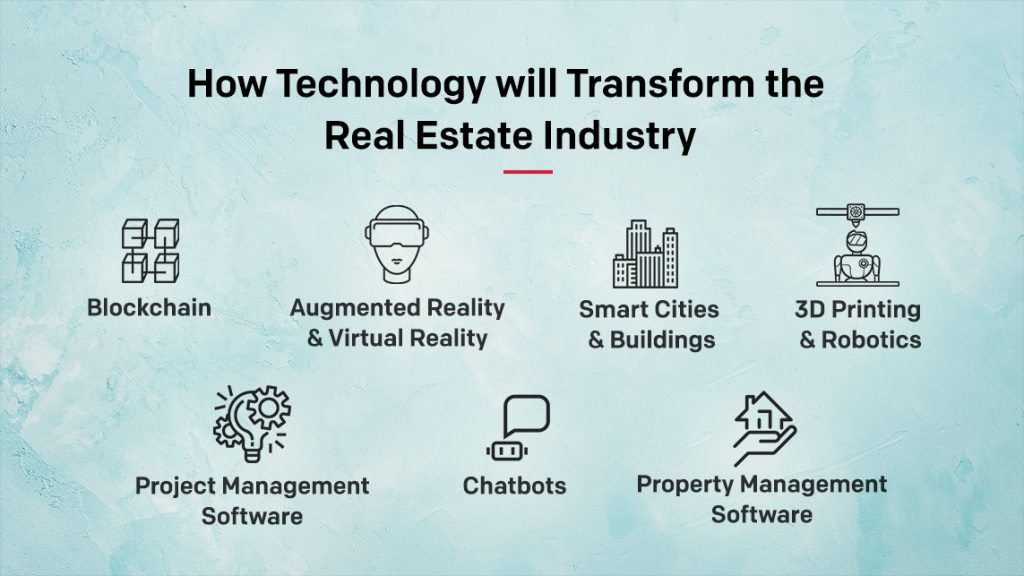
Blockchain
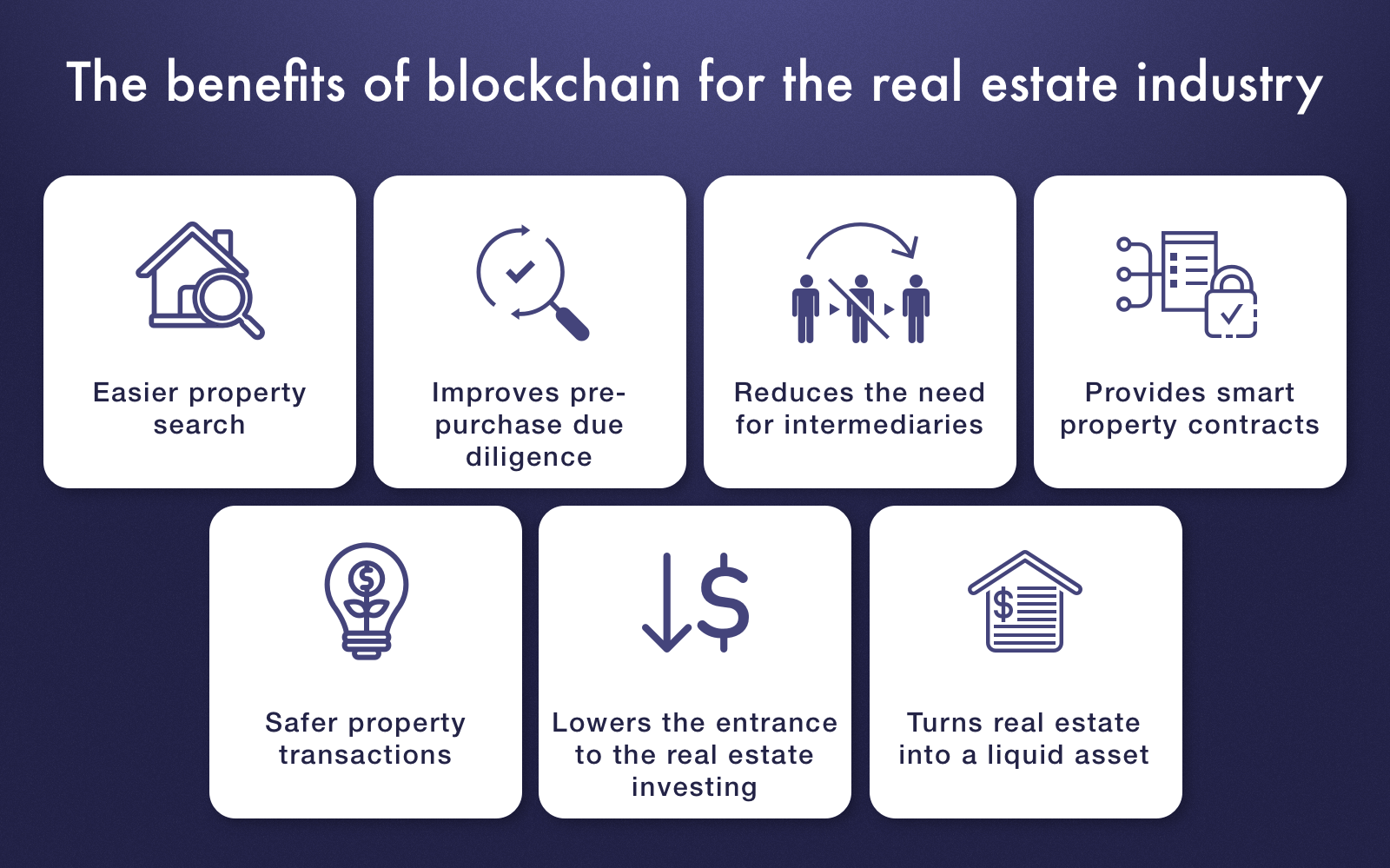

 Blockchain technology has gained prominence in real estate because it helps lower the fees and processes associated with the industry. It reduces the intermediaries involved and streamlines processes for investors purchasing commercial real estate.
 This disruptive technology in real estate creates computer-based processes to eliminate paper title deeds, paper licenses, etc. for seamless cross-border transactions. Several companies have integrated blockchain ledgers for the government to issue instant online title deed for properties.
Augmented Reality and Virtual Reality
 The use of VR is increasing as it allows visitors and investors to virtually check the properties regardless of their geographic location. The VR experience is not just limited to property touring. It also enables users to visualize any space with various customized design elements, thereby helping the interior design process. Most property listing sites enables VR or 360 videos to provide virtual tours to buyers and promote their properties.
Smart Cities and Buildings
 Smart buildings and cities are no longer a thing of the future. A smart building refers to a structure that deploys technology to automate operations such as lighting, security, and heating. Controlled partly by the Internet of Things (IoT) such technologies help boost efficiency and reduce energy waste. Technology giants like Google, Amazon, and Apple are aggressively investing in the concept of smart home technologies to transform the way people live.
 The primary aim of smart cities is to enhance the quality of life using technology. A smart city integrates IoT solutions with information and communication technology to monitor its assets such as schools, water, libraries, waste management, etc. Technology in real estate can also help control parking, streetlights, and monitor air quality and noise.
Robotics
 Construction technology, popularly known as ConTech is revolutionizing the future of construction in real estate. Presently, construction is heavily dependent on manual processes to operate heavy machines. Some of companies started incorporating unmanned bulldozers and drones to construct buildings and monitor the construction site.Unmanned drones are capable of monitoring deliveries, inventory, and progress at the site and then create a 3D map of it. The information gathered by these drones is then used to instruct unmanned bulldozers to allot courses around the site. Construction technology in real estate removes worker safety issues, allowing robots to do manual work while humans focus on more strategic tasks.
Project Management Software
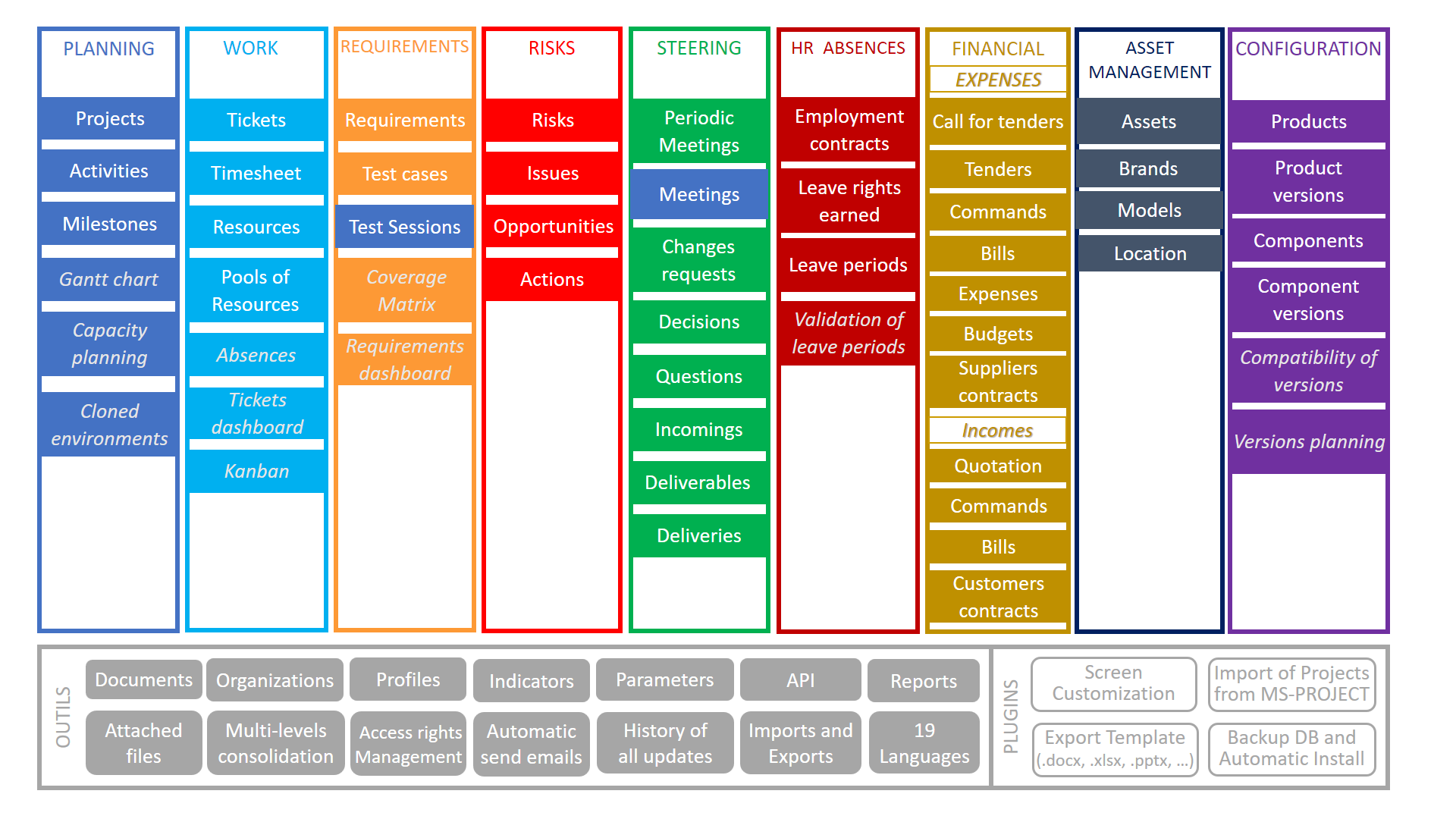 Project Manager are being deployed in real estate to assist in construction management. This is done to boost efficiency, clarity, and accountability of stakeholders involved in the project and aid in real-time conversations between them.
AI , Big Data , ML transforming Real Estate:
The Artificial Intelligence (AI) revolution has arrived.AI is already enabling self-driving cars, early-stage detection of cancer cells, smart identification of retail store locations, and voice-activated home systems that self-set alarms and thermostats.

The technology might seem daunting to many real estate agents and brokers, but a deeper understanding of the potential applications for AI and machine learning may lead to a new appreciation of the opportunities that lie ahead.“Thousands of agents and homeowners are already using it, and many many more are influenced by the invisible calculations AI makes behind the scenes. Bots, in some form or another, are literally determining everything from home prices to the colour of paint would-be buyers see in listing photos.
 ”With all eyes on AI, it’s clear that this technology will impact the future of real estate in a big way. The ability to collect analyze and learn from a huge inflow of data is promising to make agents more efficient and effective, brokers more strategic, and clients ultimately empowered to experience the buying and selling process with much less uncertainty.
Here are some ways AI will likely influence the real estate industry now and in the future.
1.Improving Home search for clients
 Ever since listings became available online, home buyers have been able to search for homes by selecting attributes like location, price, square footage and number of bedrooms. But even narrowing the property search to these parameters can still leave house hunters with hundreds of homes to consider, or worse, filter out otherwise suitable properties that don’t meet the search criteria.
Machine has made this process much less frustrating by analyzing a person’s search patterns and creating a more accurate picture of what they really want. AirBnB, for example, can combine search data from a potential home buyer with that of similar buyers to produce a list of properties prospects actively searched while connecting them with other properties that align closely to their needs — much like Amazon recommends books a customer may like to read.
Several firms have developed AI applications that will serve as conversational interfaces with customers to answer simple and complex questions, such as “does the house have a pool?” , “how many cars fit in the garage?” If a customer wants to know if the property has a backyard, such platforms can add that extra layer of detail like the features of property.
When it comes to the real estate industry, the best way to get the best chance of securing a sale is to provide clients with the property that’s perfect for them. AI-based algorithm can help to surface the perfect properties for each different viewer.
"More brokerages are discovering the value in machine learning that can help remove bias and guesswork from the recruiting process"
"More brokerages are discovering the value in machine learning that can help remove bias and guesswork from the recruiting process"
2. Refine the Transaction Process
 The goal to help agents and teams provide the most seamless and surprise-free experience for their clients — will only be enhanced by machine learning that delivers faster closing times, smarter mobile apps, solid compliance checks, detailed reporting and auto fillable data , e-sign that reduces manual data entry and errors. At the end of the day, it will also help brokers and teams accurately assess how they’re performing by providing smart, robust reports.
Transaction management is much simpler using mobile technology. Tech has also been extremely useful during the appraisal process. This period of time involves immense amounts of paperwork and can generally last a duration of time. With electronic document signing apps and automated emails, we have significantly cut down the time spent on this portion of the sale.
3. Predict Appraisals and Market Values
By combining CRM and marketplace data, AI technology may also help agents and brokers better predict the future value of a home in a specific market. For instance, the system may synthesize information from a variety of sources, including transportation, area crime, schools and marketplace activity.
 |
| Predicting the listing of property in advance |
AI can precisely predict future rent, identify future market trends and anomalies, and capture arbitrage between asking price and market price by comparing as many as 'n' property attributes and researching as far back as 'n' years on every property .
"Artificial intelligence will enable real estate agents to concentrate on the relational, intuitive and creative roles that are far beyond the capabilities of any computer"
As long as real estate continues to exist as a data-intensive business, brokerages will need to embrace the latest technology if they want to outpace the competition by winning with speed to leads and contract-to-close transactions.
Savvy players will use machine learning to their advantage by generating more quality leads with precision ,streamlining the transaction process.
For many agents and brokers, the idea of this type of technology still paints a bleak impersonal picture of the future, but experts say the net result may actually be quite to the contrary. By helping people quickly analyze the massive amount of search data that exists, smart tech will enable agents to concentrate on the aspects of their jobs that they find most rewarding — the relational, intuitive and creative roles in real estate that are far beyond the capabilities of any computer.
After all, no matter how sophisticated AI evolves, computers are not likely to master the very key characteristics clients seek in agents, such as showing empathy, building relationships, the art of the negotiation and adapting to new situations.
Chatbots
 |
| Chatbot messenger ( automated) |
AI-driven chatbots are not new, with several industries leveraging them to enhance sales and marketing performance. Most of the real estate companies with an online presence have started using chatbots to help investors with standard information related to the property, along with pictures and videos without any human intervention.
Since chatbots are 24×7 available, they provide support around the clock and assist buyers in filling contact forms even during odd hours of the day. Chatbots lower the overhead marketing and sales cost and results in higher conversion rates.
Real Estate Technology or PropTech:
Residential real estate technology
Advances in the residential side of real estate technology encompass a number of target areas, but generally aim to reduce friction in the purchase, sale, or rental of a property. Areas of focus include finding a home, selling a home, financing a purchase, closing on a property (including valuation, title & escrow, and insurance), managing a property, managing loans, and mortgage lending software.
Benefits of incorporating Technology in Real Estate Industry:
The need of the hour is a technology solution that can disrupt the real estate industry by:
Since chatbots are 24×7 available, they provide support around the clock and assist buyers in filling contact forms even during odd hours of the day. Chatbots lower the overhead marketing and sales cost and results in higher conversion rates.
Real Estate Technology or PropTech:
Real estate technology is a broad term that encompasses the application of information technology and platform economics to real estate markets. Because some goals of real estate technology include reducing paperwork or making transactions quicker and more efficient, it is often thought of as overlapping with financial technology. Contemporary digital real estate technologies could therefore include property management using digital dashboards, smart home technology, research and analytics, listing services/tech-enabled brokerages, mobile applications, residential and commercial lending, 3D-modeling for online portals, automation, crowdfunding real estate projects, shared spaces management as well as organizing, analyzing, and extracting key data from lengthy rental documents.
Investment in real estate technology
There are currently many startups trying to target every segment of the property market chain, attempting to disrupt and improve how the current market players (developers, buyers, sellers, renters, investors, and real estate professionals) design, construct, market, discover, transact and operate real estate. These startups have been supported by seed funding and investment from a range of sources, including some specialist real estate technology venture capital funds.
Advances in the residential side of real estate technology encompass a number of target areas, but generally aim to reduce friction in the purchase, sale, or rental of a property. Areas of focus include finding a home, selling a home, financing a purchase, closing on a property (including valuation, title & escrow, and insurance), managing a property, managing loans, and mortgage lending software.
The need of the hour is a technology solution that can disrupt the real estate industry by:
a) Forward Auction pricing based on real time demand and supply.
b) FacilitatingTrue Price discovery instead of using the last listing price of a speculative last transacted price as the benchmark for next transactions
c) Breaking the monopoly of scrupulous Brokers and Builders who artificially control pricing based on inventory supply modulations.
d) Bridging the Trust deficit amongst all stake holders (buyer, seller and brokers)
e) Eradicating the problems of fake, impersonated or stale listings.
f) Intuitively helping buyers search properties in a more innovative manner rather than using the outdated and obsolete approach of searching a property by using filters.
So many startups recognise the true problem statement and are making efforts in optimising the process of making smart decisions in real estate by making use of the data they provide, analysis they make , services they provide ,Technology they incorporate in their business for fractional investments or buying or selling properties. They are helping users to view the prices of all the latest properties that have been sold or rented across specific geographic area.
Common problem in real estate industry
 We all know that Real Estate is one huge sector. But despite all the efforts if there is one thing which the customer always wanted but never got till now was transparency in pricing, expensive investment ,taxes. Any user be it a buyer or seller or tenant wants to know the price of the last property that got sold or rented because they use that as a benchmark for taking their own property decisions.
Examples of a startup incorporating technology:
NO BROKER:( BUSINESS MODEL)
 NoBroker has a peer-to-peer site that allows home owners and prospective tenants to connect directly, eliminating the need for a broker. NoBroker offers a subscription model for tenants as well as owners.It is probably the only unique listing portal which uses no field agents , the reason is because of incorporating the technology in business.They collect data from different sources and analyze them to come out with the best possible outcomes for the customers.
It does not charge brokerage, has been deploying newer technologies such as artificial intelligence and machine learning to not only better its product offerings and also predicts the price of the property.The predictor is responsible for answering queries about rent depending on input criteria such as place or size of the flat in a particular region.
The predictor is fed with two scores – commute and living. These scores themselves run on individual AI and ML algorithms after considering the data it has been trained on.The commute score represents the connectivity of the city to the region where the property is located and the living score considers aspects such as size and amenities around the property. These algorithms were being trained on both data that was being crowdsourced and information collected over the years by listing properties and providing other related services such as rent payments and agreements.
“Most of our crowdsourced data that helps us get to commute and living scores come from APIs of Google Maps, Ola and Uber.
The predictor helps NoBroker showcase property prices that matches consumers’ needs and is based on a scientific method.
It runs a series of algorithms to check periphery and traffic to let the customer know how long it would take to travel between his/her office and the property.“What the consumer can do is let us know where the office is and how much travel time he expects. Based on this information we will suggest a property in a particular radius which might not be the closest, but surely will have the shortest commute time,” he explained.
Similarly ,home rental startup NestAway also uses an AI engine built in-house to predict rent.
Conclusion:
Conclusion:
All of this information can seem exciting yet intimidating to a real estate professional. Real estate technology can never replace a realtor. These resources are solely beneficial, convenient and only add to the human bond. The possibilities and opportunities for technology in real estate are virtually endless!
By
"IT'S NOT WE USE TECHNOLOGY , WE LIVE TECHNOLOGY".
By
VIJAY BODUGULA
(Jay Kannan)
(Jay Kannan)
Comments
Post a Comment